Finally, the workprint prompts a meta‑cinematic reflection: a movie is a construction, not an inevitability. The finished Die Hard 2—taut, crowd-pleasing, expertly scored—feels inevitable in retrospect because we only see the end result. The workprint reintroduces contingency: choices made, rejected, revised. For fans and students of cinema, that’s a thrill and a lesson. It’s a reminder that every moment of tension on screen was earned through a series of small, often difficult cuts and additions.

In short, the Die Hard 2 workprint is valuable beyond nostalgia. It is an archival artefact that deepens appreciation for craft: acting choices that would be refined, edits that would focus momentum, soundscapes that would be rebuilt. It invites viewers not only to relish explosive action but to inhabit the messy, creative middle ground where films become films. For anyone interested in how a summer action sequel is assembled step by step, the workprint is both a window and a mirror—showing the process and reflecting how editorial choices ultimately define our cinematic memories.

The most immediate strike of the Die Hard 2 workprint is its tone. The theatrical release tightens humor, clarifies character stakes, and speeds the narrative to maximize breathless momentum. In the workprint, by contrast, scenes often breathe more slowly; humor and menace coexist on a looser leash. John McClane—Bruce Willis’s weary, streetwise hero—feels rawer here, less wrapped in the winking popcraft that would later be gently dialed up. That rawness does something important: it reminds the viewer that McClane is a man made credible by small, impulsive instincts rather than by blockbuster invulnerability. In certain takes present only in the workprint, McClane’s reactions are quieter, more reactive—tiny behavioral details that, when excised, subtly shift a character’s interiority.

Beyond pacing, the workprint often contains alternate or deleted scenes that change our reading of secondary characters and plot logic. In sequels, where the villain’s motive can feel perfunctory, these scenes can be more than filler—they can instantiate different narrative logics. For example, variations in the villain’s exposition or in secondary character beats—airport staff, military officials, McClane’s allies—can tilt the film from a focused thriller to a broader critique of institutional incompetence. Even if those alternates are rough, they offer a glimpse at possible tonal trajectories the filmmakers considered but ultimately abandoned.

There’s a particular thrill in cinematic what-ifs, a frisson reserved for versions of films that never reached their intended mainstream audiences. The Die Hard 2 workprint occupies that liminal space: raw, rough, tantalizingly different from the polished blockbuster that lit up multiplexes in 1990. It’s not merely a curiosity for completionists; the workprint reveals at once an earlier creative impulse, alternate pacing choices, and a reminder of how editing, scoring, and final cuts shape not just scenes but a film’s emotional architecture.
Die Hard 2 Workprint -

die hard 2 workprint

EagleEye Director II имеет встроенное обновляемое программное обеспечение. Обновление программного обеспечения происходит автоматически при подключении к кодеку, либо во время обновления ПО кодека. Также можно смостоятельно произвести обновление встроеного ПО.

die hard 2 workprint

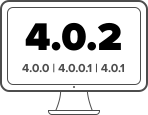
РАБОТА ДОСТУПНА с версии 4.1 Если после восстановления заводских настроек система сбрасывается до версий ПО 4.0.0, 4.0.0.1 или 4.0.1, то сначала следует установить версию 4.0.2, после чего обновляться на более поздние версии.

die hard 2 workprint

Для получения других файлов обновлений (Download Firmware), а также всей технической документации посетите страницу продукта на портале support.hp.com

die hard 2 workprint
Apr, 2022
Актуальная версия
программного обеспечения
Download
Mar 22, 2022
Приложение EagleEye Director II App
Бесплатная утилита для управления настройками и обновления EagleEye Director II с ПК


Die Hard 2 Workprint -

Finally, the workprint prompts a meta‑cinematic reflection: a movie is a construction, not an inevitability. The finished Die Hard 2—taut, crowd-pleasing, expertly scored—feels inevitable in retrospect because we only see the end result. The workprint reintroduces contingency: choices made, rejected, revised. For fans and students of cinema, that’s a thrill and a lesson. It’s a reminder that every moment of tension on screen was earned through a series of small, often difficult cuts and additions.

In short, the Die Hard 2 workprint is valuable beyond nostalgia. It is an archival artefact that deepens appreciation for craft: acting choices that would be refined, edits that would focus momentum, soundscapes that would be rebuilt. It invites viewers not only to relish explosive action but to inhabit the messy, creative middle ground where films become films. For anyone interested in how a summer action sequel is assembled step by step, the workprint is both a window and a mirror—showing the process and reflecting how editorial choices ultimately define our cinematic memories. die hard 2 workprint

The most immediate strike of the Die Hard 2 workprint is its tone. The theatrical release tightens humor, clarifies character stakes, and speeds the narrative to maximize breathless momentum. In the workprint, by contrast, scenes often breathe more slowly; humor and menace coexist on a looser leash. John McClane—Bruce Willis’s weary, streetwise hero—feels rawer here, less wrapped in the winking popcraft that would later be gently dialed up. That rawness does something important: it reminds the viewer that McClane is a man made credible by small, impulsive instincts rather than by blockbuster invulnerability. In certain takes present only in the workprint, McClane’s reactions are quieter, more reactive—tiny behavioral details that, when excised, subtly shift a character’s interiority. For fans and students of cinema, that’s a

Beyond pacing, the workprint often contains alternate or deleted scenes that change our reading of secondary characters and plot logic. In sequels, where the villain’s motive can feel perfunctory, these scenes can be more than filler—they can instantiate different narrative logics. For example, variations in the villain’s exposition or in secondary character beats—airport staff, military officials, McClane’s allies—can tilt the film from a focused thriller to a broader critique of institutional incompetence. Even if those alternates are rough, they offer a glimpse at possible tonal trajectories the filmmakers considered but ultimately abandoned. It is an archival artefact that deepens appreciation

There’s a particular thrill in cinematic what-ifs, a frisson reserved for versions of films that never reached their intended mainstream audiences. The Die Hard 2 workprint occupies that liminal space: raw, rough, tantalizingly different from the polished blockbuster that lit up multiplexes in 1990. It’s not merely a curiosity for completionists; the workprint reveals at once an earlier creative impulse, alternate pacing choices, and a reminder of how editing, scoring, and final cuts shape not just scenes but a film’s emotional architecture.

>